
 Faculty of Medicine · Suez University
4th Annual Student Symposium for Research Projects
Original research · Pre–post experimental study
Acute Effects of Energy Drinks Consumption on Vital Signs and Cognitive Performance
A pre–post experimental study among adults at Suez University and patients attending Suez University Hospital.
A research project by fifth-year medical students of the Faculty of Medicine, Suez University · Class of 2021–2026
Group meansn = 47
HRbpm
75.62
+3.02
NIBPmmHg
116.8/76.2
+3.0/+1.3
RESP/min
16.70
+0.75
TEMP°C
37.004
+0.211
- adult participants
- 47
- vital signs rose significantly
- 5 / 5
- from drink to reassessment
- 30 min
- cognitive domains improved
- 3
Abstract
The study at a glance
Key findings
- 01
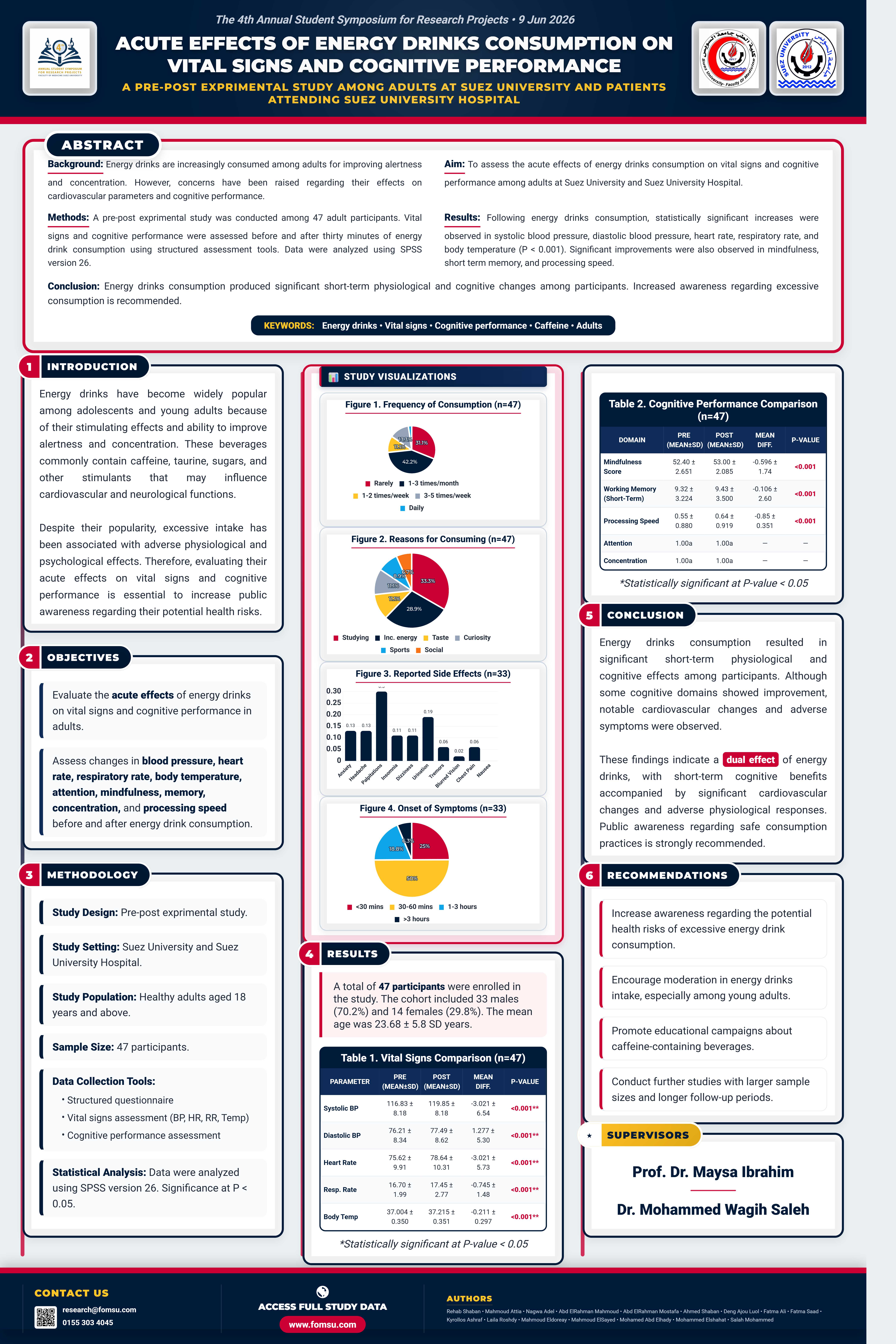
All five vital signs were higher 30 minutes after one energy drink (p < 0.001).
- 02
Mean heart rate rose by 3.0 bpm and systolic pressure by 3.0 mmHg.
- 03
Mindfulness, short-term memory and processing speed improved; attention and concentration did not change.
- 04
Palpitations were the most reported side effect (30%); half of symptoms began 30–60 minutes after drinking.
- Background
- Energy drinks are increasingly consumed among adults to improve alertness and concentration. However, concerns have been raised regarding their effects on cardiovascular parameters and cognitive performance.
- Aim
- To assess the acute effects of energy drinks consumption on vital signs and cognitive performance among adults at Suez University and Suez University Hospital.
- Methods
- A pre–post experimental study was conducted among 47 adult participants. Vital signs and cognitive performance were assessed before and thirty minutes after energy drink consumption using structured assessment tools. Data were analysed using SPSS version 26.
- Results
- Following energy drinks consumption, statistically significant increases were observed in systolic blood pressure, diastolic blood pressure, heart rate, respiratory rate and body temperature (p < 0.001). Significant improvements were also observed in mindfulness, short-term memory and processing speed.
- Conclusion
- Energy drinks consumption produced significant short-term physiological and cognitive changes among participants. Increased awareness regarding excessive consumption is recommended.
Keywords
- Energy drinks
- Vital signs
- Cognitive performance
- Caffeine
- Adults

4th Annual Student Symposium for Research ProjectsFaculty of Medicine · Suez University · 9 June 2026
Background & aim
Why we asked the question
Energy drinks have become widely popular among adolescents and young adults because of their stimulating effects and ability to improve alertness and concentration. These beverages commonly contain caffeine, taurine, sugars and other stimulants that may influence cardiovascular and neurological functions.
Despite their popularity, excessive intake has been associated with adverse physiological and psychological effects. Evaluating their acute effects on vital signs and cognitive performance is therefore essential to increase public awareness of their potential health risks.
Objectives
- Evaluate the acute effects of energy drinks on vital signs and cognitive performance in adults.
- Assess changes in blood pressure, heart rate, respiratory rate, body temperature, attention, mindfulness, memory, concentration and processing speed before and after energy drink consumption.
In context
- caffeine in a typical 250 ml can
- ≈ 80 mg
- daily caffeine considered safe for healthy adults (EFSA, FDA)
- 400 mg
- single dose without safety concern for most adults (EFSA)
- 200 mg
Sources: European Food Safety Authority (2015); US Food and Drug Administration.
Methods
How the study was done
Each participant served as their own control: the same measurements were taken immediately before and thirty minutes after drinking one energy drink.
- 01
Enrolment
Healthy adults were screened against the eligibility criteria and gave informed consent.
- 02
Baseline
Vital signs were measured and the cognitive battery was administered.
- 03
Energy drink
Each participant consumed one energy drink.
- 04
30 minutes
A thirty-minute interval allowed the acute effects to develop.
- 05
Reassessment
Vital signs and cognitive tests were repeated under the same conditions.
- 06
Analysis
Paired comparisons in SPSS version 26; significance at p < 0.05.
Study profile
- Design
- Pre–post experimental study
- Setting
- Suez University and Suez University Hospital
- Population
- Healthy adults aged 18 years and above
- Sample size
- 47 participants
Eligibility criteria
Inclusion
- Adults aged 18 years and above
- Willing to participate and provide informed consent
- Not taking medications that affect cardiovascular or cognitive function
- No history of chronic cardiovascular, neurological or metabolic disease
Exclusion
- Known cardiovascular disease (e.g. hypertension, arrhythmia)
- History of neurological or psychiatric disorders
- Regular high-dose use of caffeine or stimulant medications
- Pregnancy or breastfeeding
- Known hypersensitivity to caffeine or energy drink components
Data collection tools
A structured questionnaire recorded age, sex, occupation, smoking, medical history, medications and energy drink habits.
Vital signs
| Measure | Tool |
|---|---|
| Blood pressure | Mercury sphygmomanometer |
| Heart rate | Pulse monitoring |
| Respiratory rate | Direct observation |
| Body temperature | Mercury thermometer |
Cognitive performance
| Measure | Tool |
|---|---|
| Mindfulness | Mindfulness scale |
| Short-term memory & processing speed | Working-memory cognitive test battery |
| Attention | Digit span test |
| Concentration | Digit subtraction test |
Ethical considerations
- Informed consent was obtained from every participant before enrolment.
- Data were coded and kept confidential; participants remain anonymous.
- Participants could withdraw at any time without consequence.
- Vital signs were monitored throughout, with any adverse reaction managed immediately.
Conducted in accordance with the Declaration of Helsinki.
Results
What we found
Thirty minutes after one energy drink, every vital sign was higher and three of five cognitive measures improved.
4.1Participants
- Male · 33 (70.2%)
- Female · 14 (29.8%)
- Each dot is one participant
Age
23.68 ± 5.8years· range 18–42
Occupation
4.2Vital signs
- Before
- 30 min after
- Band = mean ± 1 SD
- Statistically significant (p < 0.05)
Systolic blood pressure
116.83 → 119.85 mmHg
Before 116.83 ± 8.18; 30 min after 119.85 ± 8.18; Change +3.02 mmHg; p < 0.001
- Change
- +3.02mmHg
- p
- < 0.001
Diastolic blood pressure
76.21 → 77.49 mmHg
Before 76.21 ± 8.34; 30 min after 77.49 ± 8.62; Change +1.28 mmHg; p < 0.001
- Change
- +1.28mmHg
- p
- < 0.001
Heart rate
75.62 → 78.64 bpm
Before 75.62 ± 9.91; 30 min after 78.64 ± 10.31; Change +3.02 bpm; p < 0.001
- Change
- +3.02bpm
- p
- < 0.001
Respiratory rate
16.70 → 17.45 /min
Before 16.70 ± 1.99; 30 min after 17.45 ± 2.77; Change +0.75 /min; p < 0.001
- Change
- +0.75/min
- p
- < 0.001
Body temperature
37.004 → 37.215 °C
Before 37.004 ± 0.350; 30 min after 37.215 ± 0.351; Change +0.211 °C; p < 0.001
- Change
- +0.211°C
- p
- < 0.001
View as table
| Measure | Before (mean ± SD) | After (mean ± SD) | Change | p-value |
|---|---|---|---|---|
| Systolic blood pressure(mmHg) | 116.83 ± 8.18 | 119.85 ± 8.18 | +3.02 | < 0.001 |
| Diastolic blood pressure(mmHg) | 76.21 ± 8.34 | 77.49 ± 8.62 | +1.28 | < 0.001 |
| Heart rate(bpm) | 75.62 ± 9.91 | 78.64 ± 10.31 | +3.02 | < 0.001 |
| Respiratory rate(/min) | 16.70 ± 1.99 | 17.45 ± 2.77 | +0.75 | < 0.001 |
| Body temperature(°C) | 37.004 ± 0.350 | 37.215 ± 0.351 | +0.211 | < 0.001 |
Change is the difference between the reported means (after − before).
4.3Cognitive performance
- Before
- 30 min after
- Band = mean ± 1 SD
- Statistically significant (p < 0.05)
Mindfulness score
52.40 → 53.00
Before 52.40 ± 2.651; 30 min after 53.00 ± 2.085; Change +0.60; p < 0.001
- Change
- +0.60
- p
- < 0.001
Working memory (short-term)
9.32 → 9.43
Before 9.32 ± 3.224; 30 min after 9.43 ± 3.500; Change +0.11; p < 0.001
- Change
- +0.11
- p
- < 0.001
Processing speed
0.55 → 0.64
Before 0.55 ± 0.880; 30 min after 0.64 ± 0.919; Change +0.09; p < 0.001
- Change
- +0.09
- p
- < 0.001
- Attention1.00 → 1.00 No change
- Concentration1.00 → 1.00 No change
Identical before and after (1.00 → 1.00). With no variation between measurements, no test statistic could be computed.
View as table
| Measure | Before (mean ± SD) | After (mean ± SD) | Change | p-value |
|---|---|---|---|---|
| Mindfulness score | 52.40 ± 2.651 | 53.00 ± 2.085 | +0.60 | < 0.001 |
| Working memory (short-term) | 9.32 ± 3.224 | 9.43 ± 3.500 | +0.11 | < 0.001 |
| Processing speed | 0.55 ± 0.880 | 0.64 ± 0.919 | +0.09 | < 0.001 |
Change is the difference between the reported means (after − before).
4.4Consumption habits & self-reported symptoms
- Rarely31.1%
- 1–3 times/month42.2%
- 1–2 times/week11.1%
- 3–5 times/week13.3%
- Daily2.2%
- Studying33.3%
- Increasing energy28.9%
- Taste11.1%
- Curiosity11.1%
- Sports8.9%
- Social6.7%
- Palpitations30%
- Frequent urination19%
- Anxiety13%
- Headache13%
- Insomnia11%
- Dizziness11%
- Tremors6%
- Chest pain6%
- Blurred vision2%
- Nausea0%
- < 30 min25%
- 30–60 min50%
- 1–3 hours18.8%
- > 3 hours6.3%
Figures 3 and 4 describe symptoms participants reported from their usual consumption.
Discussion
What it means
Our findings point to a dual effect: a small, measurable lift in some cognitive domains, alongside consistent cardiovascular stimulation and frequently reported adverse symptoms.
Our results and the literature
Cardiovascular
- Our finding
- Significant rises in heart rate, systolic and diastolic pressure, respiratory rate and temperature (all p < 0.001).
- Literature
- Consistent with acute pressor and heart-rate responses reported by Grasser et al. (2014) and Shah et al. (2019).
Cognition
- Our finding
- Improvements in mindfulness, short-term memory and processing speed.
- Literature
- Consistent with caffeine's effects on working memory described by Kennedy & Scholey (2004).
Attention & concentration
- Our finding
- No measurable change (1.00 → 1.00).
- Literature
- In line with the inverted-U arousal curve: benefits plateau and may reverse at higher doses.
Limitations
01
Sample size
The relatively small sample may limit how far the findings generalise.
02
Time frame
Only immediate effects were assessed; long-term effects were not studied.
03
Cardiac monitoring
Cardiac electrical activity (ECG) was not recorded, so electrophysiological effects linked to palpitations could not be assessed.
Conclusion
The bottom line
Energy drinks consumption resulted in significant short-term physiological and cognitive effects. The findings indicate a dual effect of energy drinks: short-term cognitive benefits accompanied by significant cardiovascular changes and adverse physiological responses.
Recommendations
- 01
Increase awareness of the potential health risks of excessive energy drink consumption.
- 02
Encourage moderation in energy drink intake, especially among young adults.
- 03
Promote educational campaigns about caffeine-containing beverages.
- 04
Conduct further studies with larger samples and longer follow-up periods.
Quiz
Test what you learned
Five quick questions drawn from the study and from caffeine safety guidance.
Question 1 of 5
About how much caffeine does a typical 250 ml can of energy drink contain?
Research team
The people behind the research
Fifth-year medical students · Faculty of Medicine, Suez University · Class of 2021–2026
Supervisors

Supervisor
Prof. Dr. Maysa Ibrahim
Direct Research Project Supervisor

Supervisor
Dr. Mohamed Wagih Saleh
Direct Research Project Supervisor

Supervisor
Dr. Nanees Kamel Hussein
Research Year Supervisor

Supervisor
Dr. Yosra Saeed Abdalla
General Research Projects Supervisor
Research team
16- Rehab ShabanTeam lead
- Mahmoud AttiaWebsite developer
- Nagwa Adel
- Abd ElRahman Mahmoud
- Abd ElRahman Mostafa
- Ahmed Shaban
- Deng Ajou Luol
- Fatma Ali
- Fatma Saad
- Kyrollos Ashraf
- Laila Roshdy
- Mahmoud Eldoreay
- Mahmoud ElSayed
- Mohamed Abd Elhady
- Mohamed Elshahat
- Salah Mohamed
Poster & citation
Read the poster, cite the work
The official poster
Presented at the 4th Annual Student Symposium for Research Projects, Faculty of Medicine, Suez University — 9 June 2026.
Cite this work
Shaban R, Attia M, Adel N, et al. Acute effects of energy drinks consumption on vital signs and cognitive performance: a pre–post experimental study among adults at Suez University. Poster presented at: 4th Annual Student Symposium for Research Projects; 2026 Jun 9; Faculty of Medicine, Suez University, Suez, Egypt.
Further reading
Peer-reviewed literature on energy drinks and health.
- 2019Energy Drinks Induce Acute Cardiovascular and Metabolic Changes Pointing to Potential Risks for Young Adults: A Randomized Controlled TrialBasrai M, Schweinlin A, Menzel J, et al. · The Journal of NutritionDOI
- 2016Energy Drinks and Their Impact on the Cardiovascular System: Potential MechanismsGrasser EK, Miles-Chan JL, Charrière N, et al. · Advances in NutritionDOI
- 2023The Dark Side of Energy Drinks: A Comprehensive Review of Their Impact on the Human BodyCostantino A, Maiese A, Lazzari J, et al. · NutrientsDOI
- 2023International Society of Sports Nutrition Position Stand: Energy Drinks and Energy ShotsJagim AR, Harty PS, Tinsley GM, et al. · Journal of the International Society of Sports NutritionDOI
- 2022Energy Drink Consumption: A Rising Public Health IssueKaur A, Yousuf H, Ramgobin-Marshall D, et al. · Reviews in Cardiovascular MedicineDOI
- 2011Health Effects of Energy Drinks on Children, Adolescents, and Young AdultsSeifert SM, Schaechter JL, Hershorin ER, Lipshultz SE · PediatricsDOI